

It’s not enough to do your best; you must know what to do, and THEN do your best.” – W. Edwards Deming
Showing posts with label injury prevention. Show all posts
Showing posts with label injury prevention. Show all posts
Tuesday, June 19, 2012

Wednesday, May 2, 2012
ANKLE STRENGTHENING PROGRAM
The program provide at the link below was created by Manuel A. Escalante, Jr. BS, ATC, EMT. If preformed three times a week, the program will help strengthen your ankles, but will not necessarily prevent injury. All exercises should be done pain free.
www.csuchico.edu/~sbarker/injury/ankle/ankle_rehab.pdf
I'd add proprioception and plyometric exercises training to the exercises on the hand out that come from the link above.
Proprioception is the body's ability to realize its place in space. If an athlete is moving into a position that could sprain his or her ankle, increased proprioception can decrease the risk by alerting the athlete to the danger. Proprioception can also increase an athlete's performance. An athlete with superior balance and awareness will be able to control his or her body more effectively. This is especially true in sports like basketball and soccer, but valuable in all sports or training. Proprioceptive training is done with balance exercises.
Step up to a step of bench, sideways and then step down sideways.
Plyometric Exercises:
www.csuchico.edu/~sbarker/injury/ankle/ankle_rehab.pdf
I'd add proprioception and plyometric exercises training to the exercises on the hand out that come from the link above.
Proprioception is the body's ability to realize its place in space. If an athlete is moving into a position that could sprain his or her ankle, increased proprioception can decrease the risk by alerting the athlete to the danger. Proprioception can also increase an athlete's performance. An athlete with superior balance and awareness will be able to control his or her body more effectively. This is especially true in sports like basketball and soccer, but valuable in all sports or training. Proprioceptive training is done with balance exercises.
Balance Training
- Standing on one leg: Hold for 30 seconds, working up to one minute per leg.
- Balance and catch: Standing on one leg, catch and throw a ball with a partner. Make certain to throw the ball right, left, high, low. Perform three sets of 30.
- One leg mini squats: On one leg do a half squat with the opposite leg out front for 10 reps, out to the side for 10 reps and behind for 10 reps. Repeat three times.
Ankle Agility
Lateral Step Up and DownStep up to a step of bench, sideways and then step down sideways.
Plyometric Exercises:
- Single Leg Hops
Hop forward and concentrate on "sticking" the landing. - Single Leg Spot Jumps
Hop from spot to spot on floor. - Reactive Spot Jumps
Place numbered pieces of tape on floor and as a partner calls out a number, hop to that number.
Monday, January 23, 2012
ACL Injury Prevention
The ACL or Anterior Cruciate Ligament is one of the four ligaments in the knee. It is the primary stabilizing ligament and comes into play when changing direction. There are between 250,000 and 300,000 ACL tears a year and almost all of them are among athletes. ACL tears take anything from 6 months to a year to recover from after surgery.
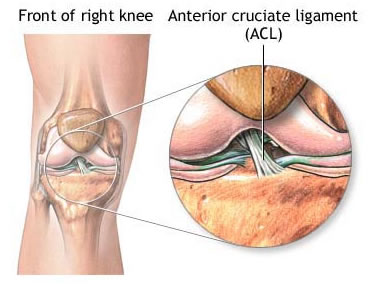
Teach young players how to move with good alignment to protect their knees. Help them to develop body awareness, strength, and balance to support knees and ankles. Have them to always jump, land, stop, and move with the knees directly over the feet. Teach them to not let their knees collapse inward. Girls must develop strength in their hips and thighs. Women are nearly three times more likely to have ACL injuries than men. And some statistics says that a female soccer player is eight times more likely to injury her ACL than a male soccer player. Researchers believe this may be due to differences in hormone levels on ligament strength and stiffness, neuromuscular control, lower limb biomechanics, ligament strength and fatigue.
Make sure that they warm up and stretch before games and practice. In your practices have them perform a variety of drills until the movement patterns are second nature and they don’t have to think about it. Teach them to say:
- Chest high and over knees
- Bend from the hips and knees
- Knees over toes
- Toes straight forward
- Land like a feather
Practice these guidelines, exercises, and drills with your team. When practicing any of these strategies, the quality of movement, rather than quantity, should be your goal.
Warm up.
- Light jogging.
- Sideways skip. Sit back, tense stomach as if you are pulling your belly button in, small steps sideways on your toes only.
- Forwards small steps. With you toes pushing up, take small steps landing with your feet flat on the ground. Your body is up right as before.
- Skipping. High knees, small steps, landing with your foot flat on the ground. Knees should be picked up as high as you can.
- Sideways skipping. Body upright with stomach in. Leading leg raised high. Feet flat to the ground.
- Backwards running. Body up right, reach back and drive with your heal.
Dynamic Non Static Stretching
- Knee grab. Grab knee and pull up towards the chest, as the knee is pulled up rise onto the toes of the standing foot.
- Heal grab. Grab heal, pull towards chest and rise up onto toes of standing foot.
- Walking knee Lunge. As above grab heal, rise up onto toes, place foot forward, lunge down keeping body upright then step forward with back foot and repeat.
- Side to side lunges. Body upright, step behind front foot, sit down on crossed legs, push up and powerfully step out with front foot, rock forwards then backwards then repeat.
- Back kicks. Rise onto toes, kick back keeping everything straight go through slowly.
- Front kicks. Rise onto toes; kick up with toes pointing back to you. Keep knee straight.
- Front kick with skip.
- Hand walk. Push up position, walk up towards hands as high as you can go then walk hands out in front of you and repeat.
Subscribe to:
Posts (Atom)